

Here’s a question I got more than once while writing these: why not just write one AI systems book? Wouldn’t that reach more people?
Maybe. But it would also be wrong.
Here’s the problem I kept running into, watching how people actually try to use AI in their work. A pastor prepping a sermon doesn’t have the same problem as a small business owner trying to fix their marketing funnel. A blogger trying to protect their voice doesn’t have the same problem as someone trying to scale customer support. The tools might overlap. The underlying problem doesn’t.
Most AI content treats all of that as one audience with one set of prompts. That’s why so much of it feels useless the moment you try to apply it to your actual work. It wasn’t written for your actual work. It was written for “everyone,” which means it was really written for no one.
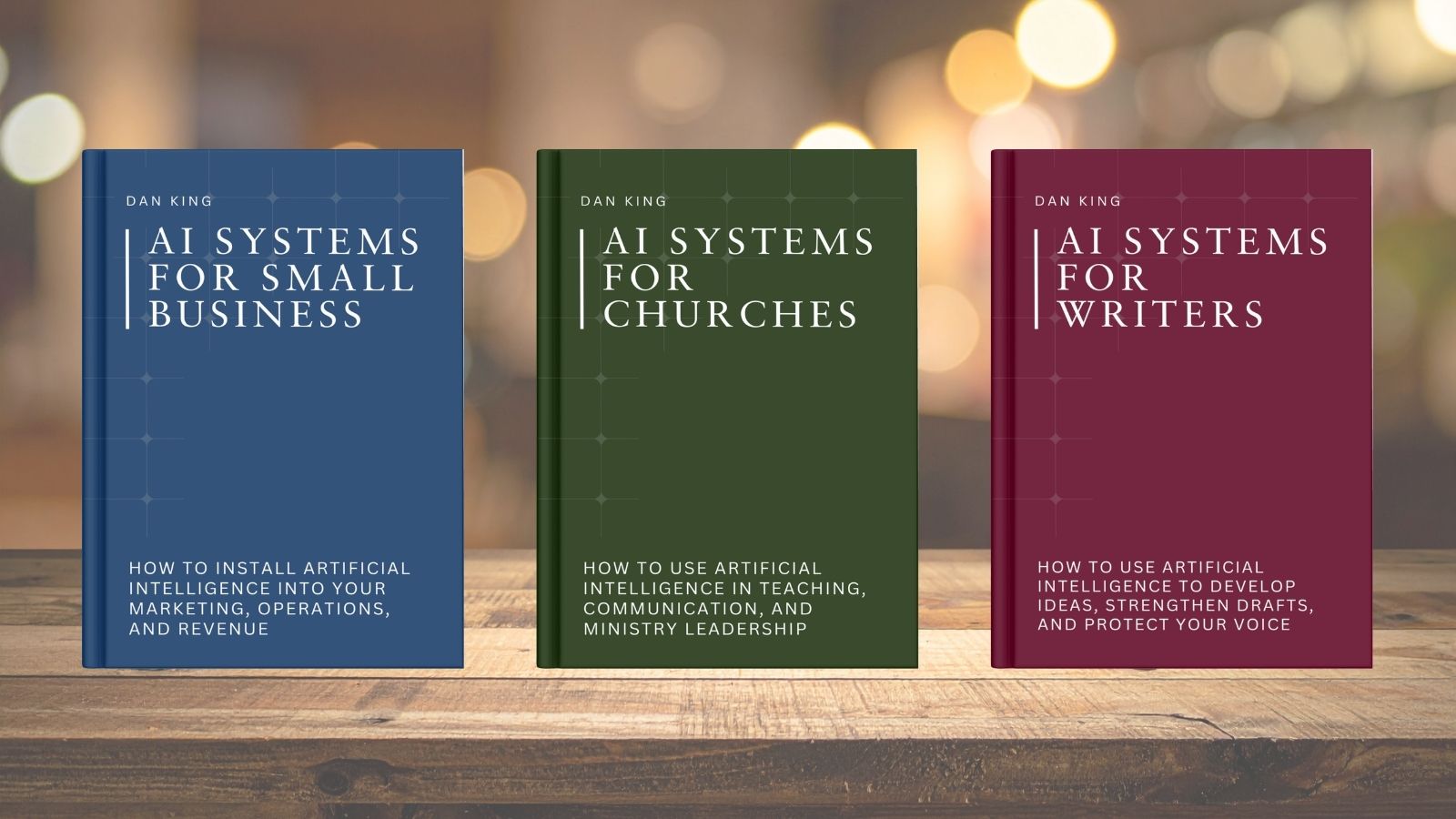
So instead of one book trying to be everything to everyone, I wrote three. Each one built around a specific problem, for a specific audience, with a specific path forward.
The Problem Underneath the Problem
Before getting into the books themselves, it’s worth naming the deeper issue, because it’s the same one across all three.
Most people’s relationship with AI right now looks like this: they open ChatGPT or Claude when they remember to, type something in, get an output, and move on. No system. No consistency. No real integration into how they actually work day to day. It’s a novelty they reach for occasionally, not infrastructure they rely on.
That’s not a failure on their part. It’s because almost nothing out there teaches AI as a system. It’s all prompts. Tips. “10 ChatGPT hacks.” None of it answers the actual question, which is: how do I build AI into the way I already work, so it makes my work better instead of becoming one more thing I have to manage?
That’s the question all three books answer. Just for three very different “how I already work.”
AI Systems for Small Business
The problem: You’re running a business with limited time, limited staff, and a marketing and operations workload that never stops growing. AI feels like it should help, but every piece of advice you’ve found is either too generic to apply or too technical to act on without a developer.
What’s inside: This book walks through installing AI into the systems that already run your business: marketing, content, sales, data, and operations. It includes a chapter specifically on rebuilding your marketing foundation when your audience or positioning has shifted, which is a problem I went through myself and rebuilt my own business around. Every chapter follows the same structure: the strategic thinking behind it, the system you build, a practical workflow, an action step you can do immediately, and a way to measure whether it’s actually working.
This isn’t theory. It’s the same approach I use running Fistbump Media, documented so you can install it in yours.
AI Systems for Churches
The problem: Ministry leaders are stretched thin, usually without a communications team, a research staff, or the bandwidth sermon prep and weekly communication actually demand. AI could help close that gap. But most AI advice doesn’t account for what’s actually at stake in ministry work: the integrity of the message, the authenticity of the pastoral voice, and the weight of getting it right.
What’s inside: This book installs AI into five ministry systems: sermon and teaching preparation, church communication, discipleship and programming, administration, and data-informed decision making. It’s built around a framework I call the AI Operating Stack, with layers for thinking, creating, optimizing, and applying intelligence to ministry work, each one building on the last. And it doesn’t shy away from the hard questions. There’s a dedicated section on guardrails: ethics, theology, and oversight, because using AI responsibly in ministry means thinking carefully about where the line is, not just where the efficiency is.
The teacher is still the teacher. The Word is still the Word. AI doesn’t replace any of that. It handles the operational weight around it so the people doing the actual ministry can focus on what matters most.
Check out: The AI Tech Stack That Can Transform Your Church’s Ministry (For About $31/Month)
AI Systems for Writers
The problem: You want to write more, research faster, and build your audience without losing the thing that makes your writing yours. Most AI writing advice pushes you toward exactly that loss: generic prompts that produce generic drafts that sound like everyone else’s generic drafts.
What’s inside: This book covers idea development, research, outlining, drafting, editing, and audience building, all built around protecting your voice instead of replacing it. It’s the system I use for my own writing and the one I teach inside AI Author Lab, expanded into a full operational guide. If you’ve read any of my recent posts on using AI inside WordPress, this book is the deeper system underneath that workflow.
What All Three Have in Common
Different audiences, different problems, same architecture. Every book in the series follows a three-part structure: strategic foundation first, then system installation, then an implementation roadmap so you actually execute instead of just reading and nodding along.
And every book shares the same core philosophy, which is really the whole point of the series: AI is augmentation, not replacement. Systems over prompts. A human still in the loop. Outcomes you can actually measure.
That’s the difference between AI as a novelty and AI as infrastructure. The novelty wears off. The infrastructure compounds.
It’s also why these books aren’t written for developers or AI specialists. One early reader of AI Systems for Churches put it better than I could in his own review:
“While readers looking for deep technical instruction may find the material introductory, that is clearly not the book’s purpose. Its audience is church leadership, not software developers. In that role, the book succeeds admirably by offering a practical starting point for thoughtful engagement with AI.”
That’s true across the entire series, not just the church book. None of these are written to make you a prompt engineer. They’re written to help you build a system you’ll actually use, whether you’re leading a church, running a business, or building an audience as a writer. The goal was never technical depth. It was operational clarity.
Where to Start
If you recognized your own problem in one of these descriptions, that’s the book to start with. You don’t need to read all three. Each one stands completely on its own, built for the specific work you’re actually doing.
The full AI Systems Series is available now on Amazon: AI Systems for Small Business, AI Systems for Churches, and AI Systems for Writers.
If you’re a blogger or content creator working through AI Systems for Writers, AI Author Lab is where that system gets built out further with hands-on support. If you’re a small business owner working through the Small Business book, AI Entrepreneur Lab does the same.





0 Comments